
How we Interpret Color

How Humans See Color: The Science Behind Vision
Color perception is one of the most fascinating aspects of human vision. While it feels intuitive—red apples, blue skies, green grass—the process behind how we see color is a complex interplay of physics, biology, and neurology. Let’s break it down step by step.
1. Light and Wavelengths: The Foundation of Color
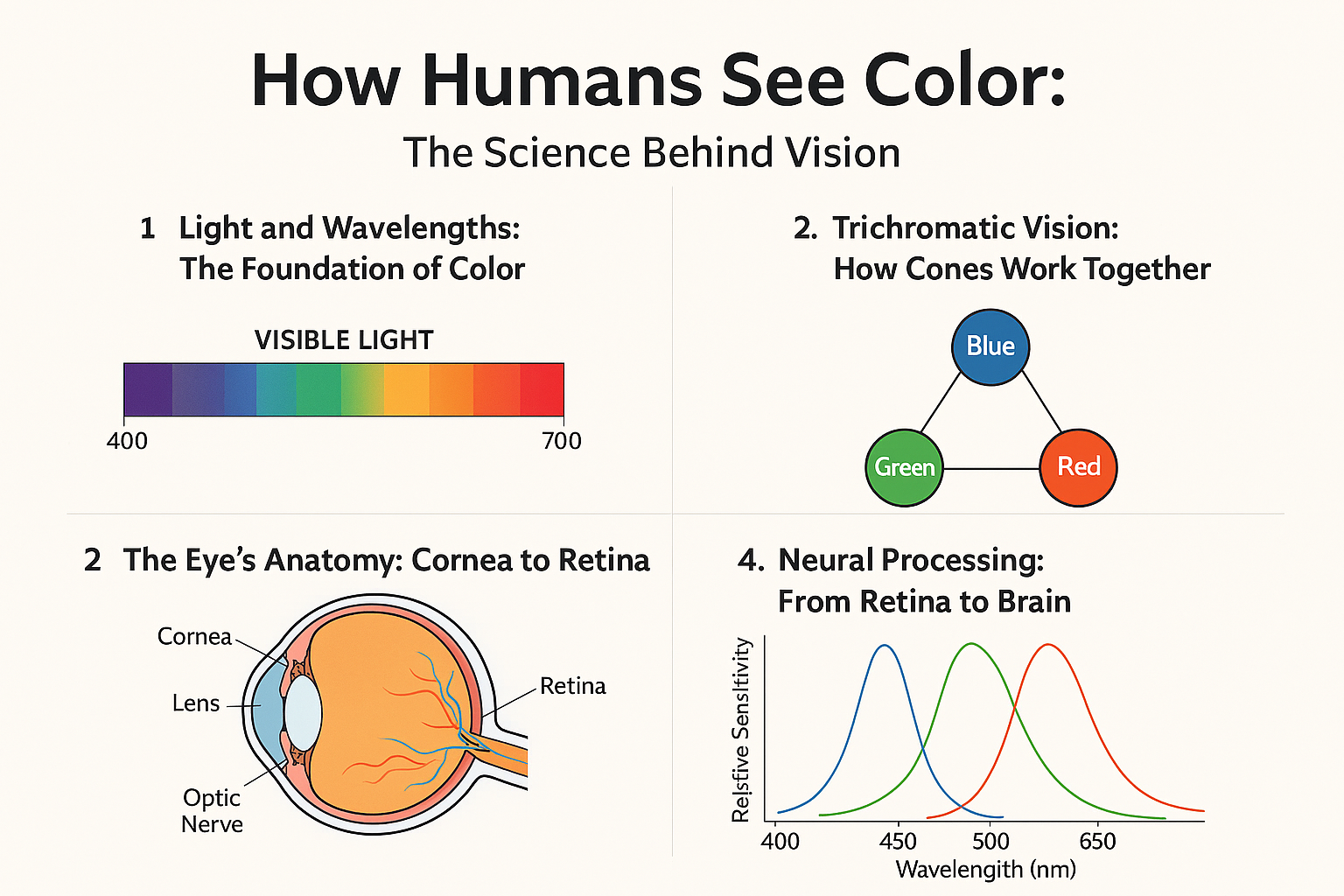
Color begins with light. Visible light is a small portion of the electromagnetic spectrum, ranging from approximately 380 nm (violet) to 700 nm (red) in wavelength. Each color corresponds to a specific wavelength:
- Violet: ~380–450 nm
- Blue: ~450–495 nm
- Green: ~495–570 nm
- Yellow: ~570–590 nm
- Orange: ~590–620 nm
- Red: ~620–700 nm
Objects don’t inherently have color; they reflect, absorb, or transmit certain wavelengths of light. For example, a leaf appears green because it reflects green wavelengths and absorbs others.
2. The Eye’s Anatomy: Cornea to Retina
Light enters the eye through the cornea, passes through the lens, and is focused onto the retina at the back of the eye. The retina contains two main types of photoreceptor cells:
- Rods: Sensitive to light intensity, enabling vision in low-light conditions. They do not detect color.
- Cones: Responsible for color vision. Humans typically have three types of cones:
- S-cones: Sensitive to short wavelengths (blue)
- M-cones: Sensitive to medium wavelengths (green)
- L-cones: Sensitive to long wavelengths (red)
3. Trichromatic Vision: How Cones Work Together
Our perception of color arises from the combined stimulation of these three cone types. For example:
- Yellow is perceived when L-cones (red) and M-cones (green) are stimulated equally.
- White occurs when all three cone types are stimulated by light across the spectrum.
This system is called trichromatic vision, and it’s why humans can distinguish millions of colors.
4. Neural Processing: From Retina to Brain
The cones send electrical signals to the optic nerve, which transmits them to the visual cortex in the brain. Here, complex processing occurs:
- Signals are compared to detect contrasts and color differences.
- The brain interprets these signals as distinct colors.
Interestingly, color perception is not absolute—it depends on context, lighting, and surrounding colors. This is why optical illusions can trick our brains into seeing colors that aren’t really there.
5. Color Vision Variations
Not everyone sees color the same way:
- Color blindness occurs when one or more cone types are absent or malfunctioning.
- Some animals have tetrachromatic vision (four cone types), allowing them to see colors humans cannot.
6. Why This Matters
Understanding color vision is crucial for fields like:
- Medicine: Diagnosing vision disorders.
- Design & Art: Creating visually appealing content.
- Technology: Developing screens and cameras that mimic human color perception.
Human color vision is a marvel of biology and physics. It starts with light, interacts with specialized cells in the retina, and ends with complex neural interpretation in the brain. Next time you admire a sunset, remember—it’s not just beautiful; it’s science in action.